Executive Summary
The Clinical Workflow Signal Audit demonstrates how workflow analytics can identify delayed clinical responses, missed escalations, and operational bottlenecks before deployment using reproducible simulation and evidence-driven reporting.
Rather than focusing on predictive models, the project evaluates operational performance by measuring signal-to-action latency, SLA compliance, workflow routing, and data quality across simulated ICU workflow events.
To support reproducible evaluation, I designed a complete evidence pipeline consisting of a simulation specification, a synthetic workflow dataset generator, and an automated metrics engine. Every reported result can be regenerated directly from the project repository, ensuring the evaluation process is transparent, repeatable, and verifiable.
The simulation generated a reproducible synthetic ICU workflow dataset together with automated evidence reports that quantify workflow performance, SLA compliance, latency, and data quality. The key outcomes are summarized below.
Workflow Events
500
Synthetic ICU workflow events
Unique Patients
497
Synthetic patient encounters
SLA Compliance
63.8%
Workflow events meeting response targets
Median Latency
36 min
Median signal-to-action time
Data Quality Issues
74
14.8% intentionally simulated
The following sections describe the clinical workflow challenge that motivated the project, the system architecture, and the reproducible evaluation pipeline used to generate the reported evidence.
Context
Modern intensive care units operate as complex information environments where patient monitors, laboratory systems, electronic medical records, nursing documentation, and clinical communication tools continuously generate and exchange clinical information. While these systems capture large volumes of data, delivering safe and timely care depends on how effectively that information is acknowledged, prioritised, escalated, and acted upon by clinical teams.
As healthcare organisations place greater emphasis on quality improvement and operational performance, understanding how information moves through clinical workflows has become as important as measuring patient outcomes. Delayed acknowledgements, missed escalations, inconsistent documentation, and prolonged response times can introduce operational risk even when the underlying clinical information is accurate.
Workflow analytics addresses this challenge by analysing how signals move from detection to action rather than focusing solely on the signals themselves. Measuring signal-to-action latency, SLA compliance, workflow routing, and data quality provides operational insight into where processes succeed and where they begin to fail.
This project models the lifecycle of simulated clinical signals as they progress through detection, acknowledgement, escalation, and completed action within an ICU workflow. A synthetic dataset and reproducible evidence generation pipeline were developed to evaluate workflow behaviour in a controlled environment, enabling repeatable analysis without processing patient-identifiable information.
Problem
Modern hospital information systems capture large volumes of clinical data, but they are not designed to evaluate workflow performance as information moves between clinical teams. While individual systems record alerts, laboratory results, documentation updates, and communication events, they often provide limited visibility into how these signals progress from detection to acknowledgement, escalation, and completed action.
As a result, operational questions such as whether an alert was acknowledged within its service-level target, whether an escalation followed the intended pathway, or where delays occurred between detection and intervention can be difficult to answer without manually reconstructing events across multiple systems.
This lack of workflow visibility makes it challenging to evaluate operational performance independently of clinical outcomes. Teams may know that an alert occurred, but have limited insight into whether workflow delays, communication gaps, or documentation quality contributed to slower responses or reduced coordination.
This project addresses that gap by modelling operational behaviour as measurable workflow events rather than isolated system logs. The objective was to develop a reproducible workflow simulation capable of quantifying signal-to-action latency, SLA compliance, workflow routing, and data quality using synthetic ICU workflow data. The resulting evidence provides an operational perspective that complements traditional clinical reporting while remaining fully reproducible.
Objectives
The project was developed around five primary objectives:
-
Model clinical workflow events as measurable operational processes by representing each stage of a workflow from signal generation through acknowledgement, escalation, and completed action.
-
Measure workflow performance using reproducible operational metrics, including signal-to-action latency, SLA compliance, workflow routing, and data quality.
-
Build a reproducible simulation and evidence pipeline capable of generating synthetic workflow events, calculating performance metrics, and producing evidence-backed reports directly from the generated dataset.
-
Design a workflow analytics dashboard that presents operational performance in a structured format, enabling healthcare teams to monitor workflow reliability and service-level performance.
-
Demonstrate a workflow-first approach to healthcare AI product design by showing how workflow analytics can complement existing clinical information systems through transparent, measurable, and reproducible evaluation.
Approach
I approached the project from a workflow analytics perspective rather than a traditional predictive AI perspective. Instead of modelling patient outcomes, the project models the operational journey of a clinical signal as it moves through an ICU workflow, from generation and detection to acknowledgement, escalation, and completed action.
The implementation was guided by three design principles.
1. Treat workflows as observable systems
Each workflow event was represented as a measurable operational process with defined timestamps, escalation states, service-level targets, and completion outcomes. This made it possible to analyse how information moved through the workflow rather than treating alerts as isolated system events.
2. Build reproducible evidence into the system
Rather than manually documenting project metrics, the system includes a reproducible evidence pipeline consisting of a simulation specification, synthetic dataset generator, automated metrics engine, and generated evidence reports. Every published metric can be regenerated directly from the project repository, making the evaluation process transparent, repeatable, and verifiable.
3. Separate analysis from implementation details
The workflow model, simulation engine, evidence generation pipeline, and dashboard presentation were designed as independent layers with clearly defined responsibilities. This separation improves maintainability, simplifies validation, and allows each layer to evolve without affecting the overall workflow model.
These principles shaped both the technical architecture and the documentation strategy, ensuring that implementation decisions remain traceable from the simulation specification through to the published evidence and final case study.
System Design
The system was designed as a layered workflow analytics architecture in which each layer has a single, clearly defined responsibility. This separation allows workflow simulation, evidence generation, operational analysis, and presentation to evolve independently while producing consistent, traceable, and reproducible outputs.
The architecture consists of five logical layers.
1. Workflow Simulation Layer
The workflow simulation layer generates synthetic ICU workflow events representing the operational lifecycle of a clinical signal. Each event captures timestamps, workflow tier, escalation state, routing behaviour, service-level targets, and data quality status, producing a reproducible dataset for downstream analysis.
2. Evidence Generation Layer
The evidence generation layer processes the simulated workflow dataset and calculates operational metrics including workflow volume, signal-to-action latency, SLA compliance, workflow tier distribution, routing behaviour, and data quality statistics. The resulting metrics are exported as both machine-readable JSON and human-readable Markdown reports, ensuring that every published result is reproducible.
3. Operational Analysis Layer
The operational analysis layer transforms raw operational metrics into aggregated insights that describe overall system behaviour rather than individual workflow events. This layer enables evaluation of workflow reliability, operational performance, and process bottlenecks across the simulated environment.
4. Presentation Layer
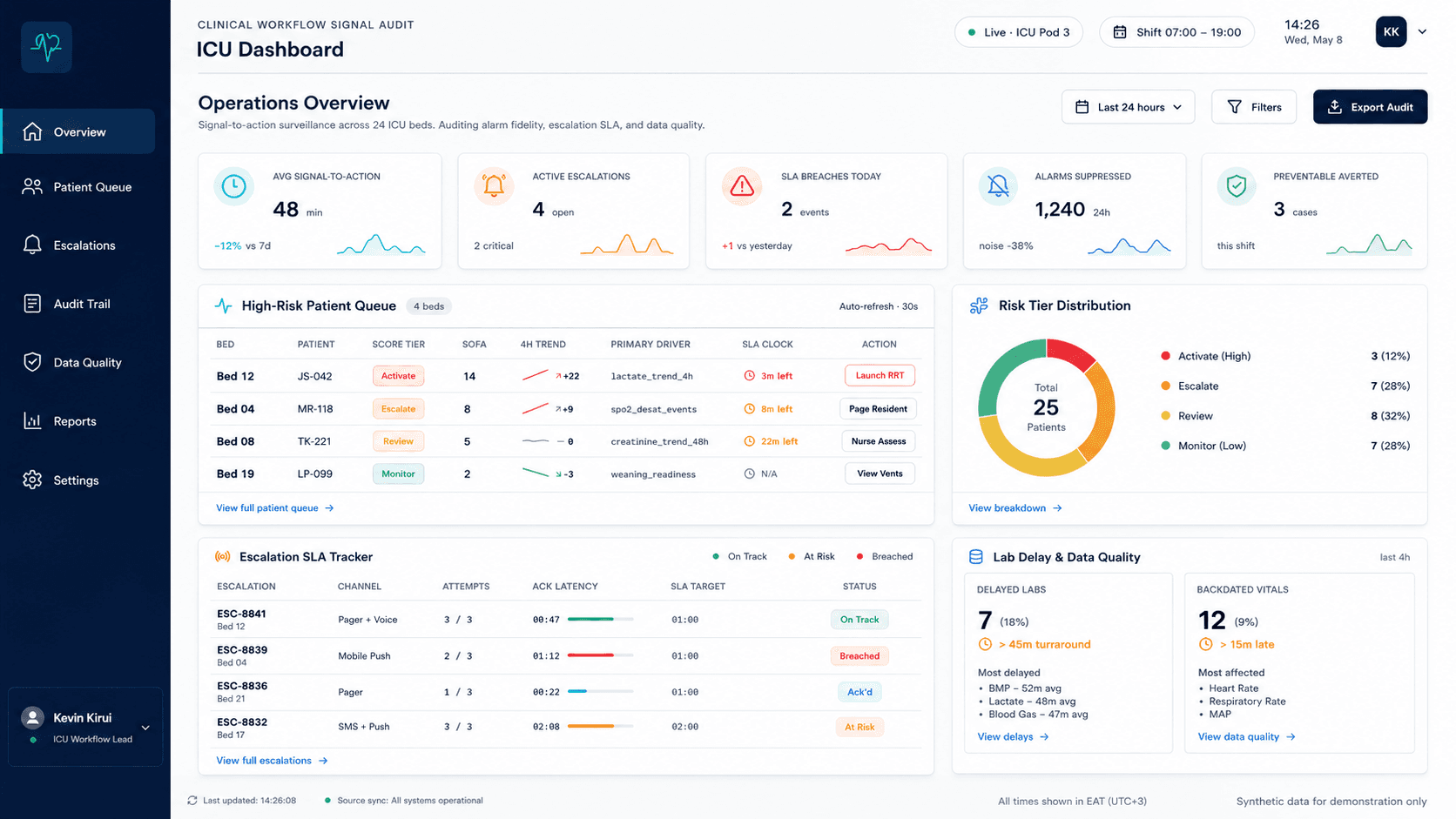
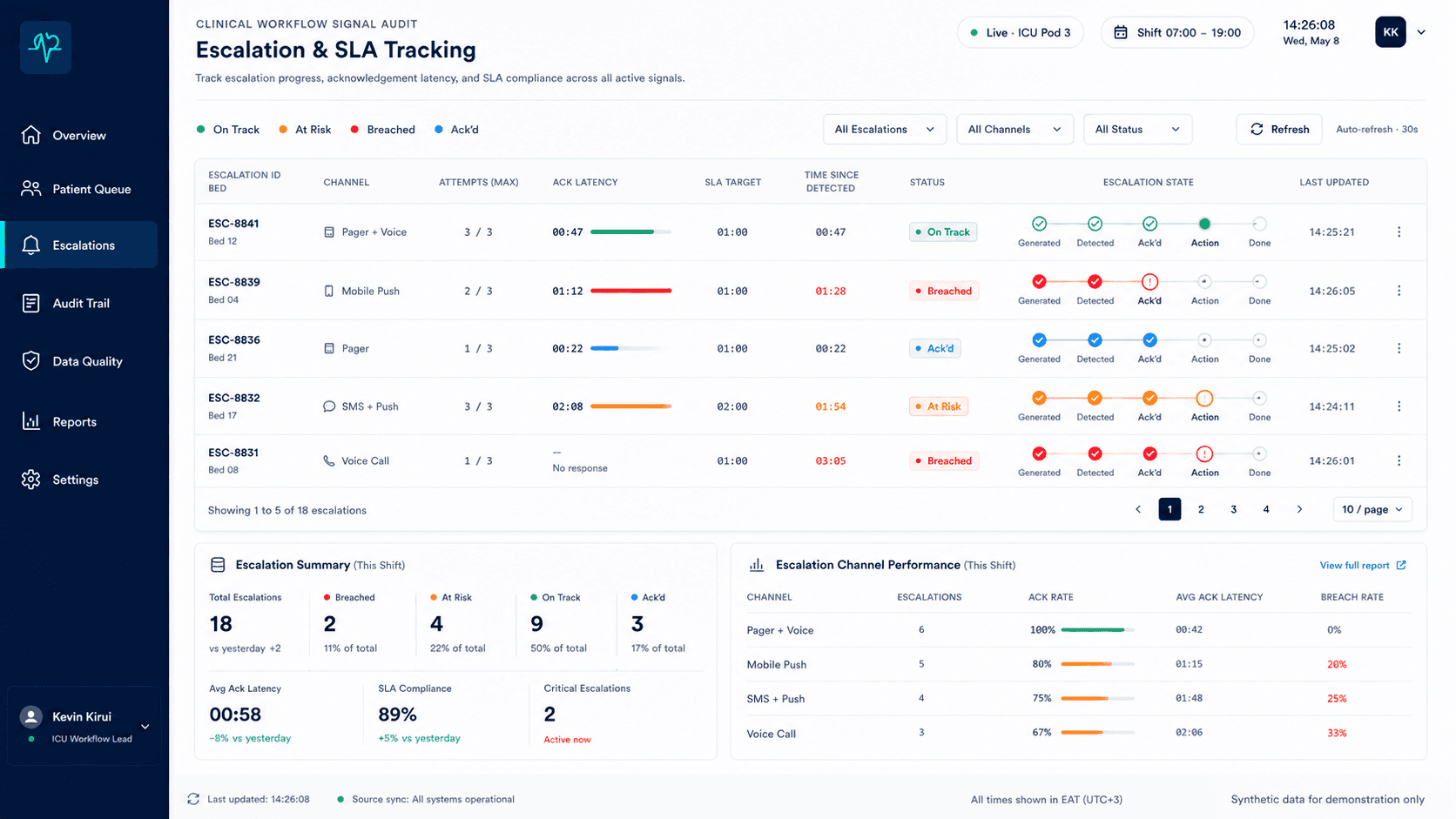
The presentation layer exposes these operational insights through role-oriented dashboard views that highlight workflow latency, escalation performance, service-level compliance, and data quality trends. Rather than presenting isolated workflow events, the interface emphasises operational visibility across the complete workflow.
5. Documentation Layer
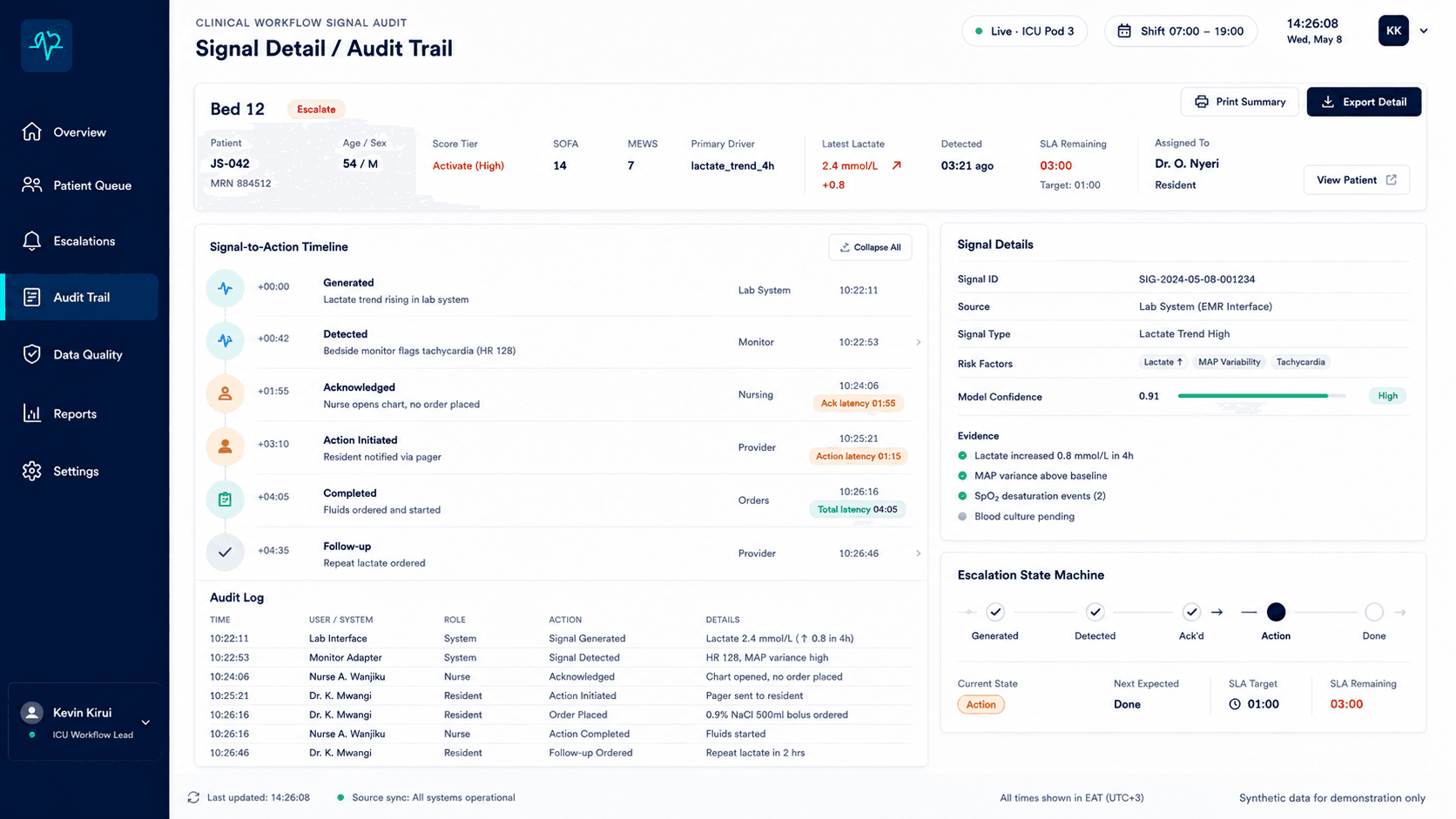
The documentation layer connects the simulation specification, generated datasets, evidence reports, project repository, and published case study into a single traceable workflow. This ensures that every reported metric, architectural decision, and implementation outcome can be traced back to reproducible project artefacts, allowing the project to evolve without losing consistency between implementation, evidence, and documentation.
Technical Implementation
The project was implemented as a reproducible workflow analytics system centred on simulation, evidence generation, and operational reporting. Rather than treating the dashboard as the primary deliverable, the implementation was structured so that every published metric could be traced back to generated workflow events and reproducible analysis.
The implementation consists of four major components.
1. Workflow Simulation
A Python-based simulation engine generates synthetic ICU workflow events that represent the operational lifecycle of clinical signals. Each generated event records timestamps for signal generation, detection, acknowledgement, action initiation, and workflow completion together with workflow tier, escalation state, routing behaviour, service-level targets, and simulated data quality conditions.
The simulation follows a documented specification, allowing identical datasets to be regenerated consistently while avoiding the use of patient-identifiable information.
2. Evidence Generation
A dedicated metrics engine processes the generated workflow dataset and calculates operational performance indicators including workflow volume, signal-to-action latency, SLA compliance, workflow tier distribution, routing behaviour, and data quality statistics.
The analysis exports both machine-readable (metrics.json) and human-readable (evidence_report.md) outputs, ensuring that every published metric is generated directly from the underlying dataset rather than being manually assembled.
3. Dashboard Implementation
The dashboard consumes the generated evidence and presents aggregated operational metrics through role-oriented visualisations. Rather than displaying individual workflow events, the interface focuses on workflow latency, escalation performance, service-level compliance, workflow tier distribution, and data quality indicators, providing an operational view of system performance.
4. Documentation and Reproducibility
Documentation forms an integral part of the implementation rather than existing separately from it. The project includes a simulation specification, reproducible dataset generator, evidence generation scripts, generated reports, and a structured technical case study. Together these artefacts create a transparent workflow in which implementation, evidence generation, and published documentation remain aligned and reproducible as the project evolves.
Results
The completed simulation generated a reproducible dataset of 500 synthetic workflow events involving 497 unique synthetic patients, providing a controlled environment for evaluating workflow behaviour without the use of real clinical data.
Analysis of the generated dataset produced the following operational results.
Workflow Events
500
Synthetic ICU workflow events
Unique Patients
497
Synthetic patient encounters
SLA Compliance
63.8%
Workflow events meeting response targets
SLA Breaches
181
Exceeded configured response targets
Median Latency
36 min
Median signal-to-action time
Mean Latency
34.4 min
Average signal-to-action time
Data Quality Issues
74
14.8% intentionally simulated
Workflow Tier Distribution
The generated workflow events were distributed across four workflow tiers, producing a realistic mix of routine monitoring, clinician review, escalation, and critical activation scenarios.
Monitor
218
Routine monitoring events
Review
157
Clinical review required
Escalate
89
Escalation workflow initiated
Activate
36
Highest-priority workflow events
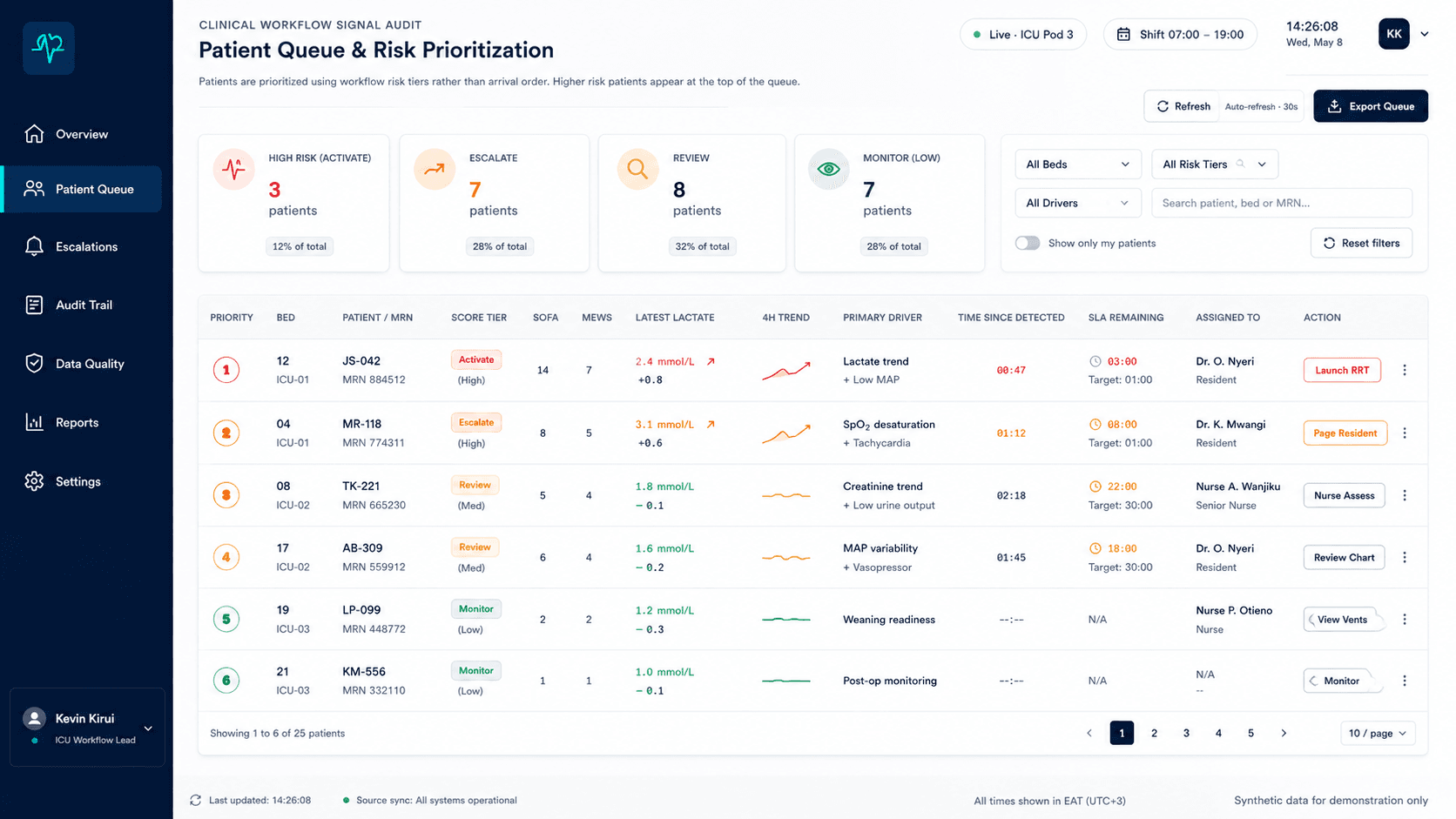
These results demonstrate that the simulation successfully models measurable operational behaviour across multiple workflow pathways while producing evidence that can be regenerated directly from the project repository. Rather than relying on manually documented outcomes, the project establishes a repeatable evaluation process in which workflow simulation, evidence generation, and reporting remain fully aligned.
Lessons Learned
This project reinforced that workflow analytics is not simply about visualising operational data. A dashboard can display workflow metrics, but those metrics become far more valuable when they are supported by reproducible evidence that explains how they were generated and what they represent.
Designing the simulation specification, synthetic dataset generator, and automated evidence pipeline fundamentally changed how I think about healthcare AI product development. Rather than manually documenting project outcomes, I now prefer building systems that generate their own evidence directly from reproducible workflows. This approach improves transparency, reduces inconsistencies between implementation and documentation, and makes future validation significantly easier.
The project also demonstrated that documentation should be treated as part of the product rather than as a separate deliverable created after implementation. Integrating simulation specifications, generated evidence, technical documentation, and the published case study into a single workflow created a traceable relationship between the implementation, generated artefacts, and published conclusions.
Perhaps the most important lesson was recognising that healthcare workflow systems should be evaluated by how reliably they measure, explain, and reproduce operational behaviour—not simply by what they display. That perspective now shapes how I approach workflow analytics, healthcare AI product design, and technical documentation.
What I'd Do Next
If I continued developing this project, I would focus on evolving the workflow analytics framework from a controlled simulation environment into a reusable operational platform capable of supporting multiple healthcare workflows.
The first priority would be introducing configurable workflow models. Rather than relying on a single simulated ICU workflow, the system should allow departments such as emergency medicine, radiology, laboratory services, and inpatient wards to define their own escalation pathways, service-level targets, workflow tiers, and operational rules.
The second priority would be expanding interoperability. Supporting healthcare standards such as HL7 FHIR would allow workflow events to be generated from realistic system interactions while maintaining a clear separation between operational workflow analysis and clinical decision support.
The third priority would be strengthening the analytics layer through longitudinal trend analysis, workflow benchmarking, and comparative reporting across departments and workflow types. This would make it possible to evaluate operational performance over time rather than analysing individual simulation runs in isolation.
Finally, I would package the workflow simulation engine, evidence generation pipeline, and reporting framework as reusable platform components rather than project-specific scripts. This would enable future workflow analytics projects to share a common simulation, evaluation, and publishing pipeline while maintaining the same reproducible evidence standard established throughout this project.
Collectively, these improvements would evolve the project from a reproducible proof of concept into a scalable operational analytics platform capable of supporting operational analysis across diverse healthcare environments.